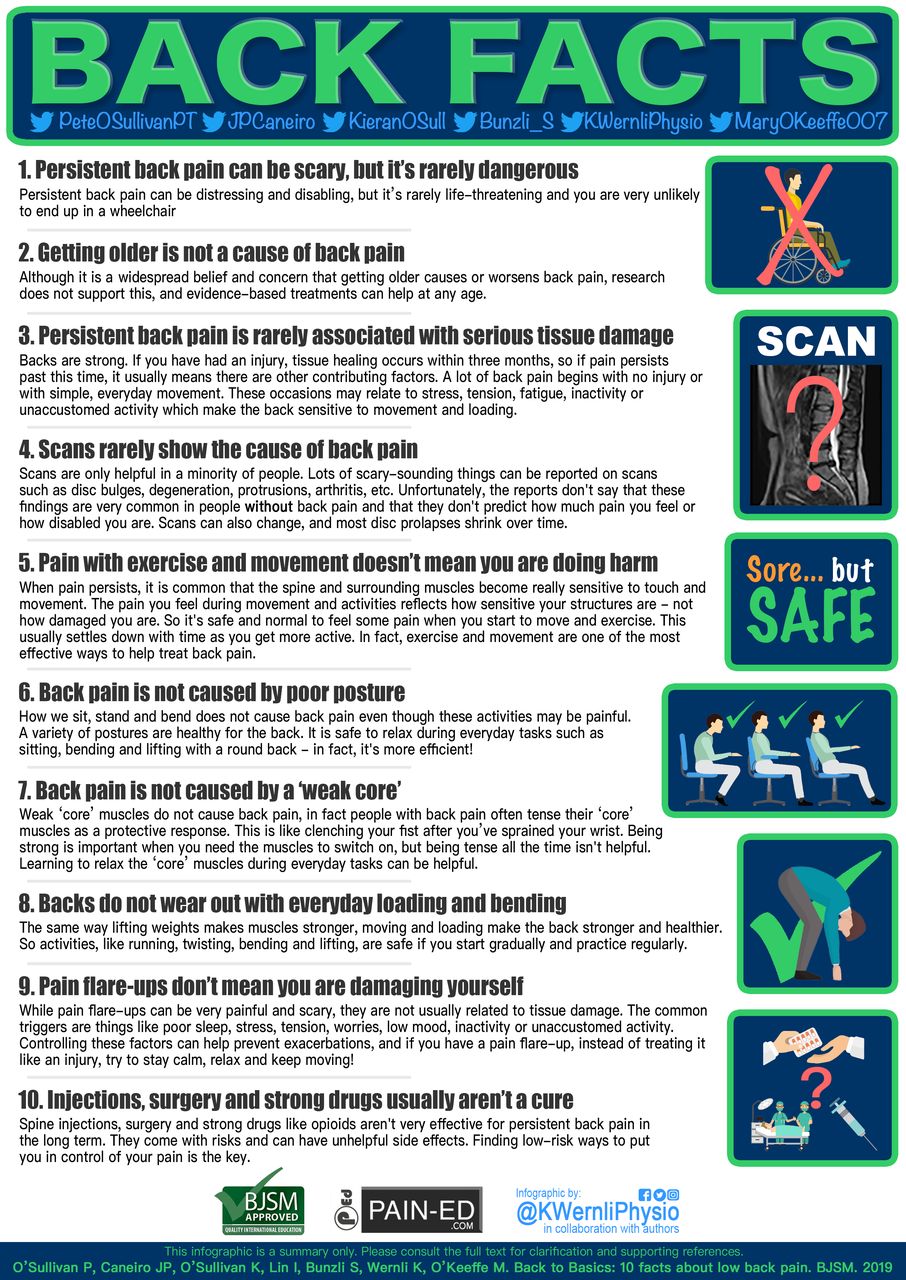

Back Pain - Unhelpful Beliefs
Here are some unhelpful beliefs when it comes to back pain – how many of these resonate?
1. Unhelpful belief: Back pain is caused by loose joints, or the spine being ‘out’ of place. Back pain means my back is damaged…
Fact: Backs are very strong, robust, mobile structures & they don’t go ‘out’ of place.
2. Unhelpful belief: Disc degeneration & disc bulges on a scan are serious signs of pathology. Back pain is just a physical, structural problem…
Fact: Back pain is rarely associated with serious tissue damage or pathology. When back pain is associated with tissue damage, healing typically occurs within 6-8 weeks. Findings on a scan such as disc degeneration & disc bulges are common in young people without back pain.
3. Unhelpful belief: Back pain needs to be rested & protected. It is dangerous to exercise, bend or lift with back pain..
Fact: Back pain is closely related to levels of muscle tension, poor sleep, mood, stress or worry. Good sleep, healthy diet, relaxed movement & exercise helps back pain. Backs get healthier & stronger with graduated movement & exercise.
4. Unhelpful belief: You need to watch your posture with back pain…
Fact: A range of postures are safe for the back. Being too sedentary isn’t good for back pain. Keep changing your postures if you have to sit for a while. Remember – your best posture is your next posture.
5. Unhelpful belief: Its not safe to carry a back-pack…
Fact: There is no evidence to suggest that wearing a backpack is unsafe for young people.
6. Unhelpful belief: Ongoing back pain means the spine is becoming more damaged…
Fact: Ongoing back pain is related to hyper-sensitivity of the spine’s structures to load & movement. This is related to many factors but is rarely linked to tissue damage.
7. Unhelpful belief: There is nothing you can do for back pain…
Fact: Back pain can be effectively managed with the right support. Back pain is rarely associated with serious damage or pathology & can be effectively managed with the right support. It helps a lot to be proactive & active.
8. Unhelpful belief: Back pain will get worse with time …
Fact: With the right care, back pain does not get worse over time
9. Unhelpful belief: A back pain flare-up means I have injured my back
Fact: Pain flare-ups are common and are usually caused by factors such as inactivity, stress and low mood.
10. Unhelpful belief: Scoliosis is a cause of back pain
Fact: While people with scoliosis may experience back pain, they are at no greater risk of back pain than those without scoliosis.
Working with a health care practitioner to coach you through this process can help you regain full confidence, mobility, a& functional capacity, especially if you feel tense, fearful & unsure about what to do.
Low Back Pain Recommended Care – including 5 questions to ask your medical practitioner…
Should I get a scan?
Scans (x-rays or other imaging) are not recommended for most young people with back pain. The exception is when ‘specific’ pathology is suspected, for example when there is:
-
- A traumatic injury, such as when a fracture is suspected
- A fever
- Progressive loss of sensation, power and/or bowel/bladder function
- Progressive weight loss and feeling unwell
Scans – what to know
Research shows that up to 30% of 16-year-olds and 45% of 21-year-olds with NO back pain show signs of disc degeneration and disc bulges. These findings occur normally and are not indicative of serious pathology.
These findings can sound scary and can lead a person to start to worry about their backs in an unhelpful way and over-protect movements and activities. Checking out our pain management modules, helps you to find ways to safely progress towards recovery from back pain.